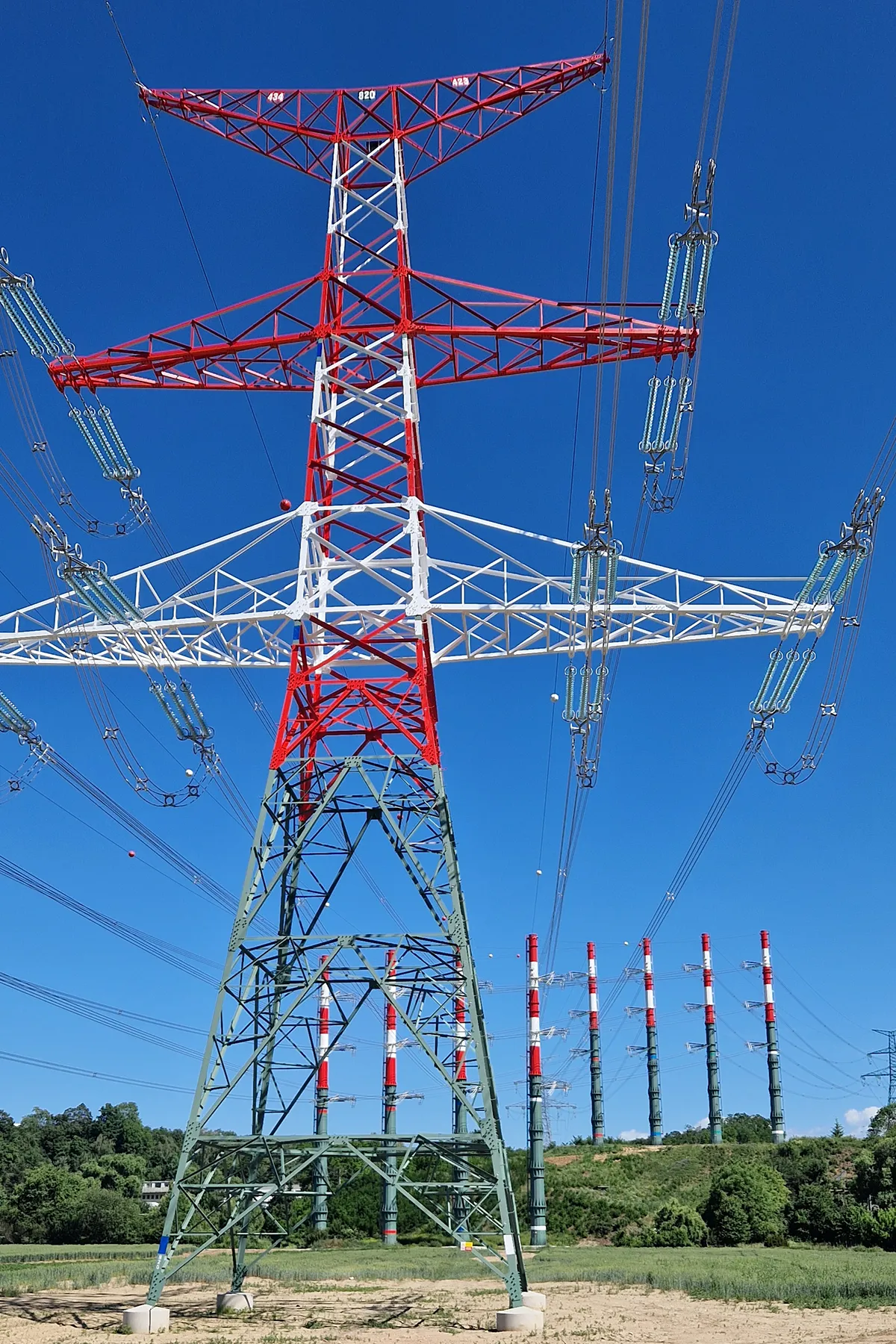
Since July 2024, we have been carrying out the project to rebuild Line V 423/422—upgrading it to higher specifications—and we are scheduled to complete it in December of this year.
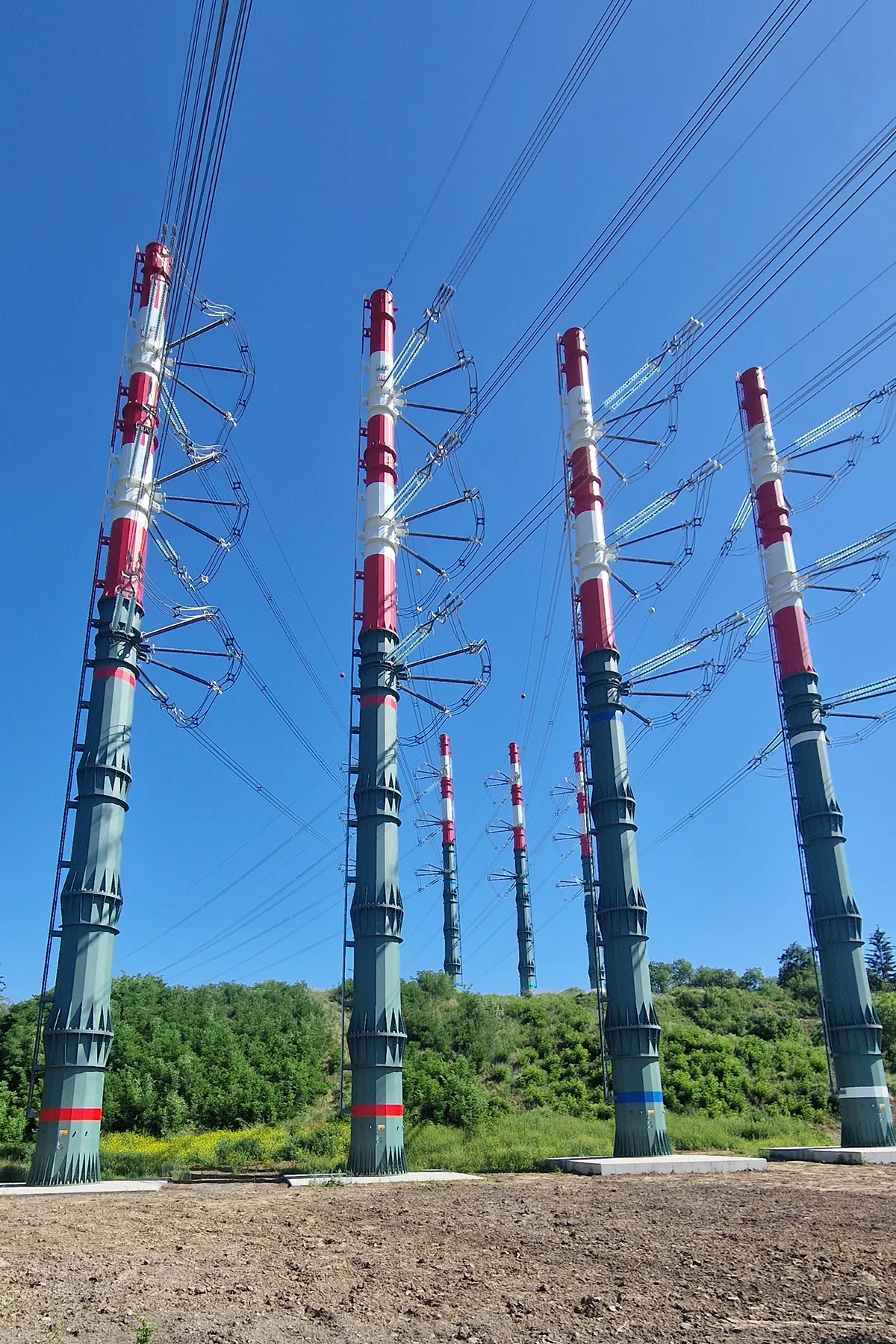
The entire project consists of ten structures of varying lengths and complexity. The most challenging part, both structurally and in terms of surveying, is the connection of structures SO 03 and SO 05 to SO 07 and SO 02. This connection is located at a terrain break with a 20-meter elevation difference near the village of Veverská Bítýška. It is being constructed using so-called angle-braced towers. We first observed portal-style braced masts in northern Bohemia in 2024 on line V487/488. Their distinctive feature is a shaft formed by a polyhedron.
In our case, it is not a portal design, but rather four “needle”-type framed towers positioned above and below a terrain break. This type is characterized by a single shaft and, just like on the V487/488 line, has the shape of a regular hexadecagon with a diameter of 960 mm at the top and a constant increase in diameter toward the base. The mast is founded on a 7 × 7-meter square foundation with a reinforced concrete cap and drilled vertical micropiles. The lower part of the foundation reaches a depth of up to 3 m. There are a total of 16 micropiles, reaching a depth of nearly 10 m.
The mast itself was transported to the construction site in individual sections and gradually assembled. It consists of 5 sections and measures a total height of nearly 50 meters. Interestingly, the total painted surface area of a single mast section is 350 m².
For this type of mast, it is necessary to precisely stake out the individual positions of the micropiles before constructing the foundations. After grouting the micropiles, the foundation slab—the lower and upper foundations—is staked out. Subsequently, the anchor grids must be precisely installed to ensure the exact position of the anchor bolts, the coaxiality of the mast, and their relative positions. Next, the verticality of the mast installation—or rather, the flatness of the foundation—is addressed. Surveying the deflections of individual cables, surveying the technical map, and preparing longitudinal profiles are further surveying tasks aimed at the handover of the project and, ultimately, the successful final inspection of the entire structure.
I am confident that everything will go well, and I thank everyone involved for their cooperation.
Pavel Hladík